As denials climb and margins hover near breakeven, healthcare’s AI shift is taking hold in claims and billing operations
Key Facts (At-a-Glance)
- What is hospital back office AI? Hospital back office AI refers to the use of artificial intelligence and automation to improve administrative operations that support healthcare delivery, including claims processing, denial management, coding audits, prior authorization workflows and revenue cycle operations.
- What is changing? Healthrise is tracking a function-by-function rebuild of the hospital back office as automation and artificial intelligence move from pilot projects into daily use across denial prevention, coding and audit quality, revenue cycle operations and workforce staffing.
- How large is the opportunity? The 2025 CAQH Index found that U.S. healthcare avoided $258 billion in administrative costs in 2024 through automation. Roughly one-quarter of provider organizations now use AI somewhere in their administrative workflows, with another $21 billion in savings still available through additional automation.
- Why are hospitals turning to automation? Hospitals are operating on margins near 1% to 3%, according to the American Hospital Association, while administrative costs consume an estimated 15% to 30% of total healthcare spending, according to a 2025 study in Health Affairs Scholar. More than 10% of medical claims are denied on first submission.
- What is the concern about AI and denials? Six in 10 physicians surveyed by the American Medical Association in 2025 said they worry AI will be used to increase, rather than reduce, claim denials. Healthrise argues that governance matters as much as the technology itself.
Artificial intelligence is increasingly changing hospital operations outside the exam room.
According to Healthrise, a healthcare consulting and technology firm specializing in revenue cycle management, electronic health record optimization and strategic advisory services, the shift is taking place inside claims queues, denial worklists and prior authorization backlogs—the administrative operations that determine whether hospitals are paid for care they have already delivered.
Why are hospitals turning to automation?
Hospitals continue to operate on margins near 1% to 3%, according to the American Hospital Association. Labor accounts for roughly half of hospital operating costs, while administrative expenses consume an estimated 15% to 30% of total healthcare spending, according to a 2025 study in Health Affairs Scholar. More than 10% of medical claims are denied on first submission, according to the Healthcare Financial Management Association, a rate that has remained stubbornly consistent even as hospitals invest more resources trying to reduce it.
The financial pressure is making automation increasingly important to hospital operations.
The industry’s longest-running benchmark on administrative automation, the 2025 CAQH Index, found that U.S. healthcare avoided an estimated $258 billion in administrative costs in 2024 through electronic transactions. Roughly one-quarter of provider organizations and more than half of health plans now use AI somewhere in their administrative workflows. Another $21 billion in savings remains in manual processes that have yet to be automated.
How is regulation increasing the pressure on hospital administrative operations?
Beginning this year, new federal rules require health plans to answer prior authorization requests within 72 hours for urgent cases and seven days for standard requests before transitioning to standardized electronic submissions by January 2027.
Physicians and their staff currently spend an average of 13 hours each week managing prior authorizations and handle roughly 40 requests per physician, according to the American Medical Association. Nearly all say the process contributes to burnout.
Why does governance matter when hospitals adopt AI?
Despite the potential for automation to reduce administrative work, skepticism remains.
Six in 10 physicians in the same American Medical Association survey said they worry AI will be used to increase—not reduce—claim denials.
Healthrise says that concern underscores the importance of pairing AI with transparent workflows, oversight and accountability.
“The AI conversation in healthcare has been dominated by what happens in the exam room,” said David Farbman, chief executive officer of Healthrise. “The more immediate opportunity, and the more immediate risk, sits in the back office, in the thousands of small decisions that determine whether a hospital gets paid for care it has already delivered.”
How is Healthrise using AI to address hospital back office operations?
Healthrise’s work with hospitals and health systems illustrates where the transformation is gaining momentum across denial prevention, audit quality and workforce management.
How is AI being used to prevent denials?
Within Healthrise’s Qodex platform, the Denials Navigator module uses AI-driven models to surface trends buried in claims data before they turn into write-offs. It recently expanded with an embedded LLM layer and has reduced denial inflow by an average of 25% for health systems using it.
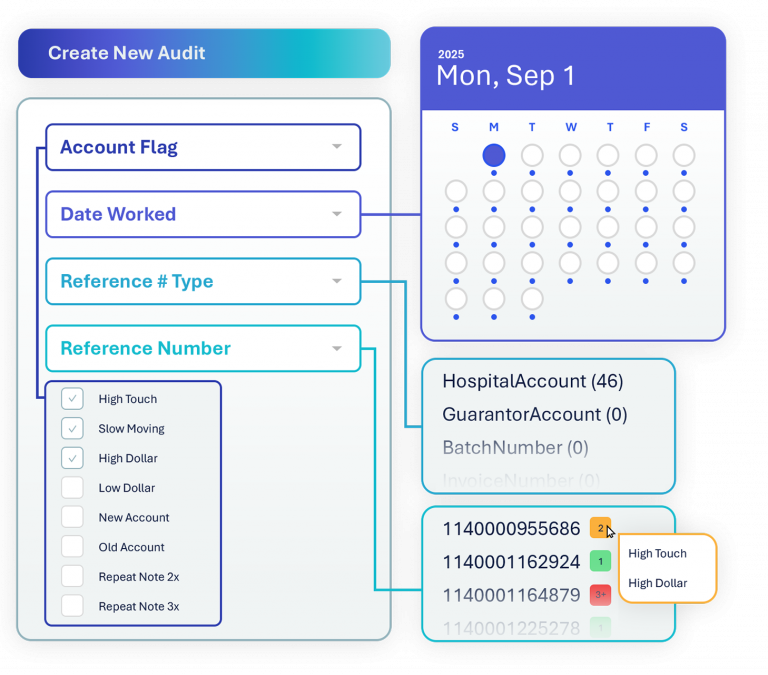
Complementing Denials Navigator, the Quality Audit & Productivity (QAP) module’s Smart Account Selection feature uses data-driven flags to automatically surface high-risk accounts. The feature turns audit findings into targeted workflows that help prevent denials before they happen.
One health system used Navigator AI to uncover a high-impact denial issue tied to a single payer and location, an issue that could have taken significant manual effort to identify across thousands of accounts.
“As a Patient Access leader, our teams are constantly balancing competing priorities, so time is one of our most valuable resources. Denials Navigator has eliminated much of the manual work that used to require hours of spreadsheets, pivot tables, and data mining to understand where our opportunities were,” said Greg Phillips, Regional Patient Access Director of a large non-profit health system. “The platform quickly highlights the areas that need attention, allowing us to focus on operational improvements instead of searching for the problem. It’s helped us be far more proactive in preventing denials while still managing the day-to-day demands of our operations. The Navigator also easily tracks denials once fixes are put in place – either we got it right on the first attempt and we can celebrate with a tangible impact or we need to tweak our solution and try again.”
How is AI being used to improve revenue cycle audit quality?
Health systems are using Healthrise’s Quality Audit Platform (QAP) to bring greater consistency and accountability to revenue cycle performance.
The platform provides standardized scoring and reporting across revenue cycle teams, supported by automated workflows and real-time alerts that flag issues as they surface. Using the platform’s Audit, Coach, Measure workflow, organizations can pinpoint underperformance, deliver targeted coaching and track progress over time, with team members improving from below-compliance audit scores to consistent top performance in fewer than 90 days.
One 900-bed academic health system saw the impact firsthand after implementing QAP.
How is AI being used in hospital workforce management?
On the workforce side, Healthrise’s Demand Workforce platform applies AI-driven shift matching to help hospitals fill nursing vacancies faster while reducing reliance on premium contract labor.
The platform is a direct response to a workforce shortage that has left nursing departments among the hardest in hospitals to staff consistently without contract labor.
One health system deployed Demand Workforce across six regional hospitals, more than 7,000 staff members and 110 scheduling zones in less than one month from kickoff to go-live.
What determines whether hospital AI delivers meaningful results?
For Healthrise, the distinction is not simply whether hospitals adopt AI. It is whether AI is embedded into disciplined operational workflows capable of driving measurable improvement.
That difference is likely to separate organizations that realize meaningful financial and operational gains from those that simply add another software platform to an already fragmented technology stack.
“Automation without governance just moves the bottleneck,” said Farbman. “If a health system doesn’t have the workflow discipline to act on what the technology finds, the technology becomes one more system nobody fully trusts.”
Healthrise plans to continue expanding its technology portfolio across denial prevention, audit quality, workforce management and revenue cycle operations as health systems increasingly look to consolidate fragmented point solutions into a more connected, governed operating model ahead of upcoming federal prior authorization requirements.
To learn more about Healthrise’s approach to automation and AI across the revenue cycle, visit www.healthrise.com.
About Healthrise
Healthrise is a healthcare consulting and technology firm that provides revenue cycle management, electronic health record optimization and strategic advisory services to hospitals and health systems across the United States. Founded in 2012, the company partners with organizations to improve financial and operational performance through customized, data-driven solutions. Healthrise has supported more than 25 health systems and managed over $35 billion in net patient revenue, helping clients strengthen long-term sustainability and care delivery. For more information, please visit www.healthrise.com.