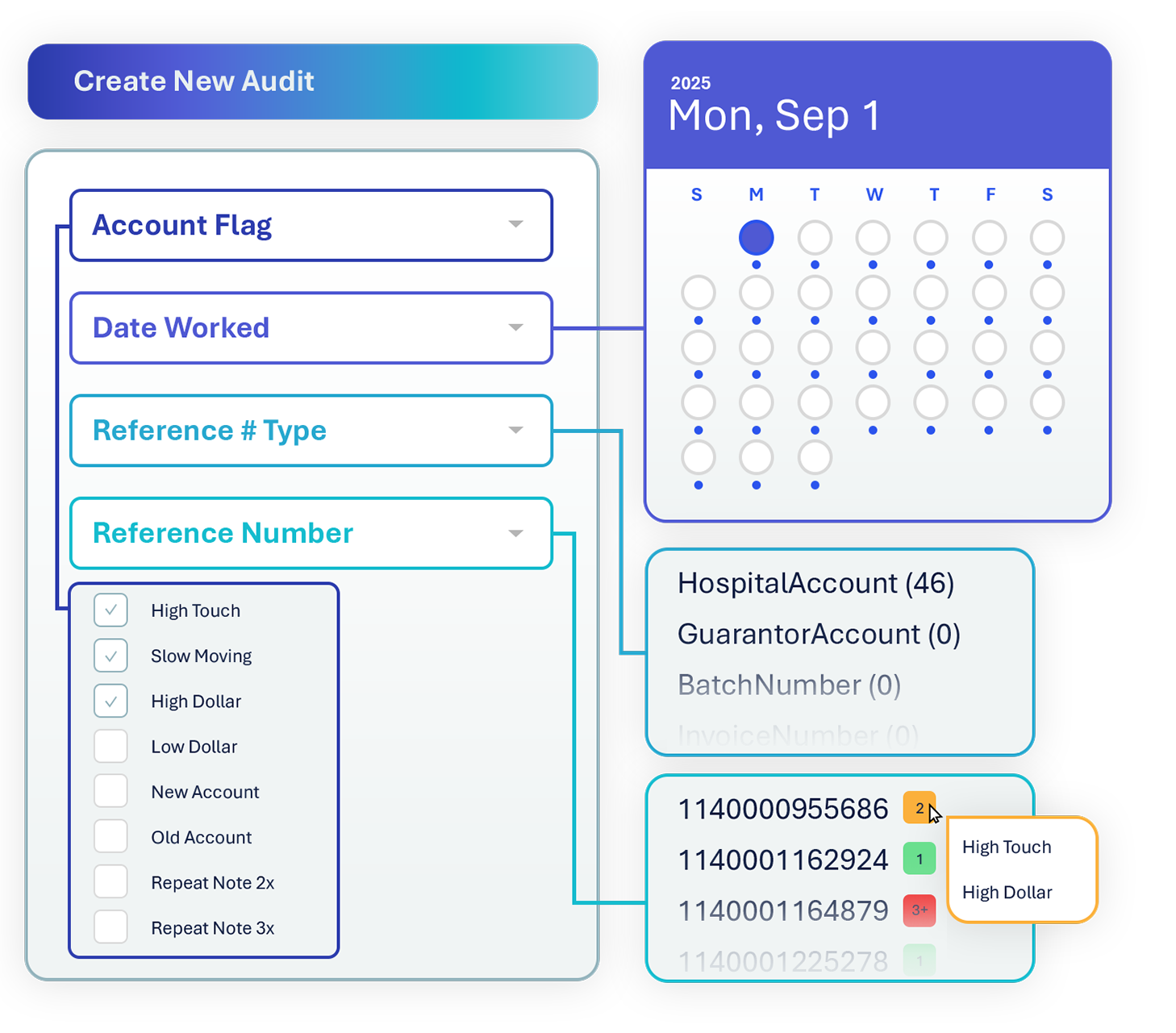
New capabilities help health systems prioritize high-risk accounts, identify revenue cycle issues earlier and connect audit findings directly to corrective action
Key Facts (At-a-Glance):
- What’s new: Healthrise added Smart Account Selection and Real Time Alerts to its Quality Audit Platform.
- What is Smart Account Selection? A risk-based account prioritization capability that uses configurable data signals to identify accounts for review.
- What risks can it identify? Configurable signals can include financial risk, payer behavior, billing errors and indicators associated with downstream denials.
- How does it improve auditing? Reviewers can filter and prioritize accounts based on specific audit objectives, helping focus audit resources on accounts with defined risk signals.
- What is Real Time Alerts? A notification capability that immediately alerts the team member responsible for an account when an auditor flags an issue, with the flagged account and auditor comments delivered by email and in the application.
- How does the workflow close the loop? Team members can correct and resolve flagged issues, while the notification, response and resolution are automatically documented in the monthly assessment.
- Can account selection be automated? Yes. Selection logic and risk models can run automatically, keeping prioritized accounts available for ongoing review.
- What happens after an issue is identified? The workflow connects issue identification, notification, correction and resolution documentation, helping reduce manual handoffs between auditors and revenue cycle staff.
Farmington Hills, Mich. (Sept. 18, 2026)—Healthrise, a healthcare consulting and technology firm, today announced two new capabilities for its Quality Audit Platform (QAP): Smart Account Selection and Real Time Alerts. The capabilities are designed to help hospital and health system revenue cycle teams prioritize accounts based on defined risk signals, identify billing issues earlier and move findings directly into a documented resolution workflow.
Together, the capabilities expand quality auditing from a primarily retrospective review process into a more targeted workflow that connects account selection, risk identification, issue notification and resolution.
What is Smart Account Selection?
Smart Account Selection is a risk-based account prioritization capability that helps revenue cycle teams determine which patient accounts should be reviewed based on configurable data signals and audit objectives.
Rather than relying exclusively on random account sampling, Smart Account Selection allows reviewers and managers to define and filter audit populations using specific risk metrics. Depending on an organization’s audit objectives, those metrics can include indicators of:
- Financial risk
- Payer-specific behavior
- Billing errors
- Downstream denials
- Other defined account-level risk characteristics
The selection logic and risk models can run automatically, allowing prioritized accounts to remain available for ongoing review without requiring teams to manually identify accounts one at a time.
“Revenue cycle teams can only review a finite number of accounts, so the ability to prioritize those accounts based on meaningful risk signals is critical,” said Tiffany Naughton, Principal Data Scientist at Healthrise. “Smart Account Selection helps put higher-risk accounts in front of reviewers first, so teams can identify issues sooner, understand patterns across their audit populations and direct limited audit resources toward the areas that warrant closer attention.”
How does risk-based auditing work?
Risk-based auditing uses available data to identify accounts with characteristics that warrant additional review. Instead of giving every account the same probability of selection, a health system can configure selection criteria around the types of issues it is trying to identify.
For example, an organization may prioritize accounts associated with a particular payer behavior, billing error or financial risk indicator. Reviewers can then evaluate those accounts, document findings and identify recurring patterns across payers, account types or staff.
This approach can also help revenue cycle leaders use audit findings beyond individual account corrections. When similar issues appear across multiple accounts, the findings can help identify opportunities for targeted coaching, staff training or process improvement.
“Data-driven account selection gives organizations a way to connect their audit strategy to the risks they are actively trying to identify,” Naughton said. “That creates a more focused audit population and gives teams a clearer view of where issues may be occurring across the revenue cycle.”
What are Real Time Alerts?
Real Time Alerts is a QAP capability that automatically notifies the team member responsible for an account when an auditor identifies an issue during an account review.
When an auditor flags an issue, the responsible team member receives the flagged account and the auditor’s comments through email and within the application. The team member can then review and correct the issue and mark it as resolved.
The system automatically documents the notification, response and resolution as part of the team member’s monthly assessment.
This creates a closed-loop workflow:
Audit → Issue identified → Responsible team member notified → Issue corrected → Resolution documented
The workflow is designed to reduce reliance on disconnected handoffs through email, Microsoft Teams and manual tracking and to shorten the time between identifying an issue and taking corrective action.
Why does proactive quality auditing matter?
Traditional quality audits often rely on retrospective reviews and random samples to assess performance. Random sampling can provide a broad view of activity, but it does not necessarily prioritize accounts based on the specific risks an organization is seeking to identify.
A risk-based approach allows health systems to direct audit capacity toward accounts with defined risk signals. When combined with real-time issue notification, the approach can also reduce the time between finding an issue and communicating it to the person responsible for correcting it.
The goal is to identify and address revenue cycle issues earlier, before they contribute to downstream denials, additional rework or financial impact.
“The value of a quality audit is not simply knowing that an issue occurred,” said David Farbman, CEO of Healthrise. “The greater opportunity is connecting the finding to the person who can address it while there is still an opportunity to act. Smart Account Selection helps teams determine where to focus, while Real Time Alerts helps move those findings into action.”
What do the new Healthrise capabilities provide?
The combination of Smart Account Selection and Real Time Alerts gives revenue cycle teams a connected workflow for:
- Prioritizing accounts: Select accounts using configurable risk metrics and data signals.
- Focusing audit capacity: Direct reviewers toward accounts aligned with specific audit objectives.
- Automating selection: Run selection logic and risk models on an ongoing basis.
- Identifying issues earlier: Surface potential billing and revenue cycle issues through targeted account reviews.
- Notifying responsible staff: Deliver flagged accounts and auditor comments through email and the QAP application.
- Closing the loop: Allow responsible team members to correct and resolve identified issues within the workflow.
- Documenting resolution: Automatically capture notifications, responses and resolutions as part of the monthly assessment.
- Identifying broader patterns: Use findings across accounts, payers and staff to inform training and process improvement.
By connecting risk-based account selection with real-time issue notification and documented resolution, Healthrise’s Quality Audit Platform is designed to help health systems move from simply measuring revenue cycle quality to taking more timely action on identified issues.
To learn more about Healthrise’s Quality Audit Platform and data-driven approach to revenue cycle performance, visit www.healthrise.com.
About Healthrise
Healthrise is a healthcare consulting and technology firm that provides revenue cycle management, electronic health record optimization and strategic advisory services to hospitals and health systems across the United States. Founded in 2012, the company partners with organizations to improve financial and operational performance through customized, data-driven solutions. Healthrise has supported more than 25 health systems and managed over $35 billion in net patient revenue, helping clients strengthen long-term sustainability and care delivery. For more information, please visit www.healthrise.com.
Release Summary
- Healthrise expanded its Quality Audit Platform with Smart Account Selection and Real Time Alerts to help healthcare organizations identify and address revenue cycle issues earlier.
- Smart Account Selection uses configurable risk metrics and data signals to identify and prioritize patient accounts for quality review, including indicators related to financial risk, payer behavior, billing errors and downstream denials.
- Real Time Alerts notifies the team member responsible for an account when an auditor identifies an issue, delivering the flagged account and auditor comments through email and within the application.
- The new capabilities connect risk-based account selection, quality auditing, issue notification and resolution documentation within a single workflow.
- The expanded platform is designed for hospital and health system revenue cycle teams seeking to move beyond random account sampling and manual issue tracking toward more targeted, proactive quality auditing.
Frequently Asked Questions
What is Healthrise’s Quality Audit Platform?
Healthrise’s Quality Audit Platform is a technology solution designed to help hospital and health system revenue cycle teams conduct quality audits, identify account-level issues and document findings and resolutions.
What is Smart Account Selection?
Smart Account Selection is a risk-based account prioritization capability within the Healthrise Quality Audit Platform. It uses configurable risk metrics and data signals to identify accounts that warrant review.
How does Smart Account Selection work?
Revenue cycle reviewers and managers can select and filter accounts using risk metrics aligned with their audit objectives. Selection logic and risk models can also run automatically to maintain prioritized accounts for ongoing review.
What types of risks can Smart Account Selection identify?
Organizations can configure selection criteria around indicators such as financial risk, payer behavior, billing errors and factors associated with downstream denials.
How is Smart Account Selection different from random account sampling?
Random sampling selects accounts without necessarily prioritizing specific risk characteristics. Smart Account Selection allows organizations to create targeted audit populations based on defined risk metrics and audit objectives.
What are Real Time Alerts?
Real Time Alerts is a capability that automatically notifies the team member responsible for an account when an auditor flags an issue during a review.
How do Real Time Alerts work?
When an auditor identifies an issue, the responsible team member receives the flagged account and auditor comments by email and within the Healthrise application. The team member can then address the issue and mark it as resolved.
How are audit issues documented?
The notification, response and resolution are automatically documented in the team member’s monthly assessment, creating a documented workflow from issue identification through resolution.
How do the two capabilities work together?
Smart Account Selection helps determine which accounts should receive attention, while Real Time Alerts helps ensure identified issues reach the appropriate team member quickly. Together, they connect account prioritization with issue resolution.
Who can use these capabilities?
The capabilities are designed for hospital and health system revenue cycle teams, including reviewers and managers responsible for quality auditing and account-level performance.
Why are these capabilities relevant to revenue cycle management?
By prioritizing accounts based on defined risk signals and connecting audit findings directly to responsible team members, the capabilities are designed to help revenue cycle teams identify and address issues earlier in the audit process.