The pace of digital transformation in healthcare has never been faster or more critical. Health systems are navigating increasing financial pressure, workforce shortages, and regulatory complexity, all while striving to maintain patient-centered care. Amid these challenges, the ability to harness reliable, scalable data is quickly becoming a defining competitive advantage.
Yet many organizations still rely on outdated data architectures that weren’t designed for today’s demands. These legacy environments often fail to deliver the real-time insights required to optimize operations, prevent denials, or adapt to evolving payer requirements.
Future-proofing your revenue cycle technology begins with building a modern data architecture that enables agility, unlocks insights, and provides the foundation for advanced analytics and automation.
The Problem with Legacy Architectures
Legacy revenue cycle systems were built primarily for transactional processing, not insight generation. This creates significant barriers for health systems:
- Rigid and siloed structures make it difficult to integrate data across departments or facilities.
- Manual, error-prone workflows reduce scalability and slow productivity.
- Compatibility issues with modern tools, creating unnecessary costs and slowing innovation.
As revenue cycle analytics needs expand, whether for denial prevention models, payer contract monitoring, or workforce optimization, these outdated architectures become a bottleneck to transformation.
What Makes a Data Architecture “Modern”?
A modern revenue cycle data architecture is a flexible ecosystem designed for interoperability, scalability, and actionable insights. The hallmarks include:
- Cloud-native infrastructure that scales on demand while reducing cost.
- Modular, API-enabled systems that integrate seamlessly without custom development.
- Unified data models connecting operational, clinical, and financial data into a single view.
- Robust governance frameworks that ensure data quality, security, and compliance.
Rather than siloed point solutions, a modern architecture fosters a composable environment, where systems can evolve independently yet remain connected.
Steps to Future-Proof Your Tech Stack
- Establish a Unified Data Layer: Consolidate disparate sources into a centralized warehouse or lakehouse for a single source of truth.
- Design for Governance and Trust: Build data confidence with metadata management, access controls, and validation frameworks.
- Enable Interoperability: Use vendor-neutral platforms and standards like FHIR to enable seamless integration across EHRs, claims engines, and financial systems.
- Plan for AI/ML and Automation: Capture structured, labeled data that can fuel predictive models and automation initiatives.
- Support Self-Service Adoption: Equip leaders and front-line staff with intuitive tools for accessing and acting on insights without relying solely on IT or data science teams.
Real-World Use Cases of Modern Data Architectures
The benefits of modernization extend well beyond IT. Revenue cycle leaders can achieve measurable ROI, such as:
- Faster Denials Intelligence: Reduce denial rates by analyzing payer and provider trends in near real time.
- Contract Performance Monitoring: Detect underpayment patterns early by linking claims data with contract terms.
- Clinical and Financial Integration: Bridge care delivery and revenue cycle by aligning on documentation, audits, and risk-prone procedures.
Where to Start and How Healthrise Can Help
Every organization’s modernization journey is unique. Some are just beginning to untangle legacy systems, while others are exploring advanced analytics and automation at scale. Regardless of where you are, Healthrise helps build data-driven strategies that balance today’s challenges with tomorrow’s opportunities.
How Healthrise partners with health systems:
- Assessing current-state architecture and identifying technical debt.
- Designing tailored roadmaps aligned with enterprise and financial goals.
- Implementing scalable solutions that empower both leadership and front-line teams.
- Optimizing EHR workflows and leveraging technology to streamline operations.
By combining revenue cycle expertise with technology innovation, we help organizations reduce denials, protect revenue, and unlock performance gains that last.
Conclusion
The future of healthcare finance is data-driven, automated, and scalable. By investing in a modern revenue cycle architecture today, health systems can future-proof their operations, maximize ROI on EHR and technology investments, and gain a strategic edge in an increasingly competitive market.
If your organization is ready to reimagine its revenue cycle technology, Healthrise is here to guide the way.
Contact us today to learn more about our hands-on approach and premier software designed specifically for health systems and hospitals to optimize performance, improve financial outcomes, and streamline workforce management.
Discover Our Full Technology Product Suite:
Denials Navigator
Centralize and standardize tracking for all denials prevention efforts and results across your health system to proactively tackle denial challenges with unparalleled efficiency and precision.
Quality Audit + Productivity
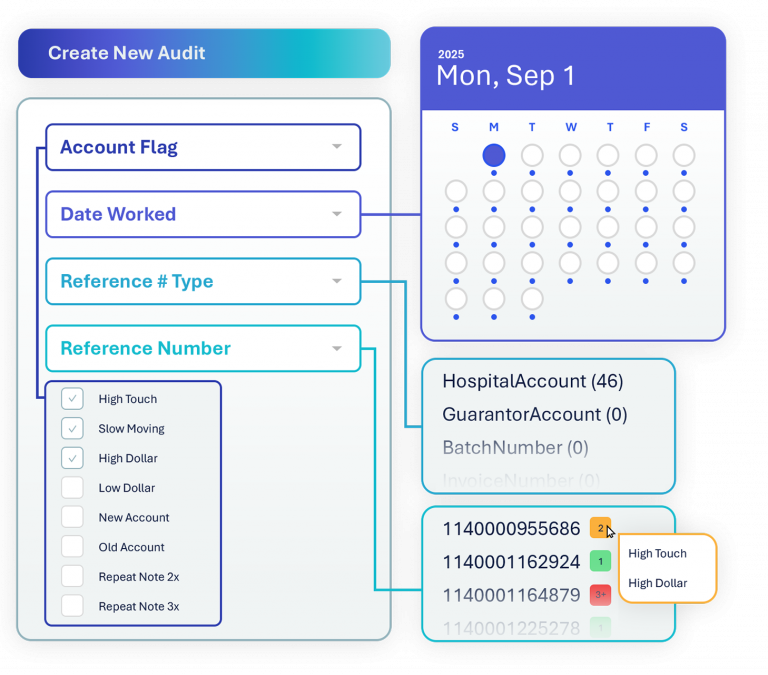
Streamline the auditing process, provide comprehensive reporting capabilities, and facilitate staff assessments, all in one user-friendly platform. With QA+P, managers can easily identify areas for education and process improvements across all revenue cycle teams.
Revenue Cycle Analytics
Powered by advanced algorithms and intuitive dashboards, our platform provides comprehensive insights into revenue cycle performance, allowing hospitals to identify trends, pinpoint areas for improvement, and optimize workflows.
Demand Workforce
Optimize and simplify how charge and staff nurses fill available shifts, enhancing staffing efficiency with our cloud-based web and mobile app.