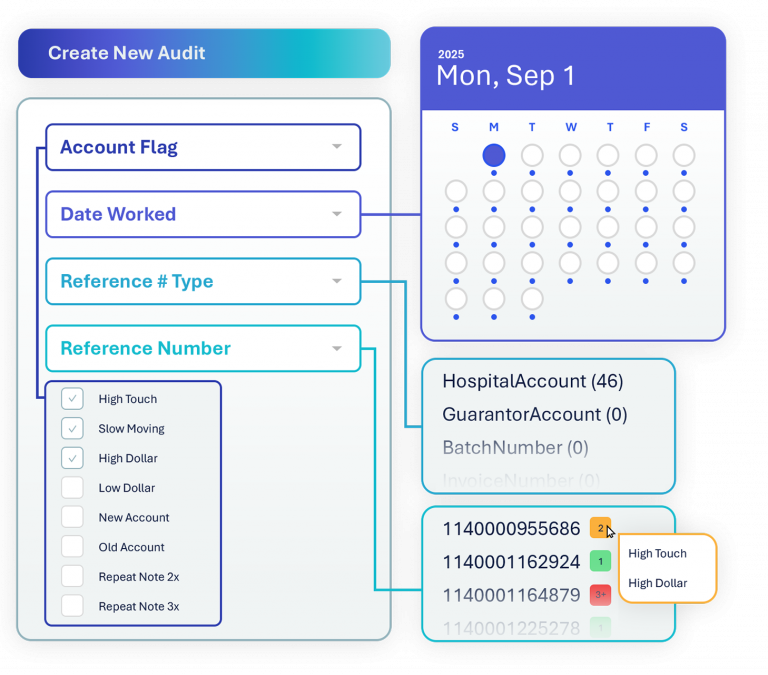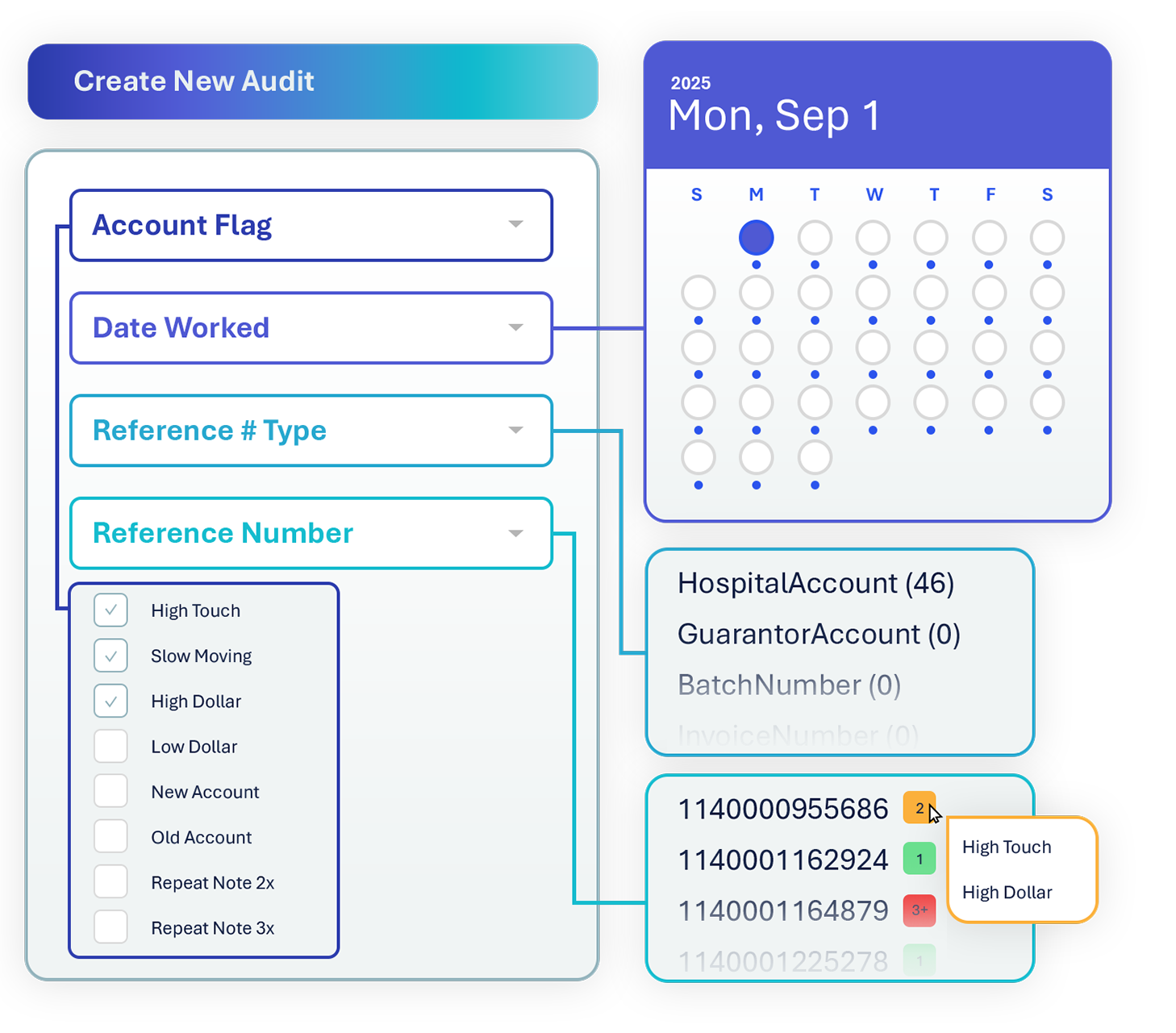
Random sampling in quality audit has a fundamental flaw: it does not distinguish between a low-risk account and a high-dollar account at risk of denial. Healthrise’s Smart Account Selection capability changes that by using data-driven risk signals to put the right accounts in front of reviewers at the right time.
The Problem with Random Sampling in Quality Audits
Traditional quality audit programs pull accounts at random. While administratively simple, this approach dilutes signal with noise. Reviewers spend time on clean, low-value accounts while genuinely problematic accounts, those with registration issues, billing errors, or payer-specific risk, go unreviewed until they produce denials or rework.
The result is a quality program that tells you what went wrong after the fact, rather than preventing issues before they compound.
What Is Smart Account Selection in Healthcare Quality Auditing?
Smart Account Selection is a data-driven approach to building audit queues. Instead of random pulls, it uses configurable risk metrics to surface accounts that have a specific reason to be reviewed: accounts with elevated financial risk, payer-specific behavior patterns, or signals that indicate a higher likelihood of downstream denials.
“Targeted account selection is really about surfacing accounts that have a specific reason to be there. We develop individual metrics, each one capturing a distinct signal. Those metrics can range from something straightforward like an account balance filter to joining together datasets in a way that gives you a view of the account you could not get from any single source alone.”
— Tiffany Naughton, Principal Data Scientist, Healthrise
Reviewers and managers select which risk metrics to filter by, narrowing the queue to exactly the population they need to focus on. The result, as Naughton describes it, is a focused, purposeful review list rather than a sea of accounts to sort through.
How Risk-Based Auditing Improves Reviewer Efficiency
Reviewer capacity is finite. In most quality audit programs, each auditor touches only a small number of accounts per month. That makes account selection a high-stakes decision.
“Time is limited. Reviewers typically are only looking at a handful of accounts each month for each team member, so making sure those accounts were selected for a reason really changes the value of each review. You start finding issues faster and catching patterns that might never surface in a random sample.”
— Tiffany Naughton, Principal Data Scientist, Healthrise
When accounts share a risk characteristic, reviewer findings become more actionable. Managers can identify which staff members are struggling with a specific payer’s requirements, where billing errors are clustering, and where targeted training will have the greatest return.
Moving from Retrospective Review to Proactive Denial Prevention
Most audit platforms today are systems of record. They document what reviewers found. Healthrise’s approach is designed to close the gap between when an issue occurs and when it gets caught.
“Logic and models can run overnight, so accounts are ready for review in the tool the next day. It starts to close the gap between when something goes wrong and when it gets caught, which is really the direction you want to move in. You are not just reviewing history; you are getting closer to catching things while there is still time to do something about them.”
— Tiffany Naughton, Principal Data Scientist, Healthrise
Holly Harp, Product Manager for Healthrise’s Quality Audit platform, sees Smart Account Selection as a fundamental shift in how audit programs create value: “For too long, quality audit has been treated as a compliance checkbox. What we built changes that entirely. Smart Account Selection transforms the audit queue from a random list into a strategic tool, surfacing the accounts where intervention has the highest impact. When front-end and back-end teams can act on risk-flagged accounts quickly and with confidence, you stop chasing problems after the fact and start preventing them at the source. That is how quality audit becomes a true driver of revenue cycle performance.”
Key Benefits of Intelligent Account Selection for Revenue Cycle Teams
- Reduces time spent reviewing low-risk, low-value accounts
- Surfaces high-dollar and denial-prone accounts for priority review
- Enables faster pattern detection across payers, account types, and staff
- Supports targeted coaching and training grounded in real account risk
- Closes the gap between issue occurrence and audit intervention
- Helps prevent denials before accounts reach the payer
How Healthrise Automates Quality Audit Prioritization
Healthrise builds intelligent account selection directly into its Quality Audit platform, not as an add-on but as a core capability. Configurable risk metrics, automated overnight processing, reviewer workflow management, and performance analytics all operate within a single environment.
For organizations evaluating how to modernize quality audit programs, the Healthrise platform offers a path from manual, random-sample-based review to automated, risk-driven auditing at scale.
Explore the Healthrise Quality Audit platform: healthrise.com/technology-qa-productivity
Frequently Asked Questions
What is smart account selection in healthcare quality auditing?
Smart account selection uses configurable risk metrics and data signals to build audit queues based on account risk rather than random chance. It surfaces accounts most likely to contain billing errors, registration issues, or denial risk, so reviewers focus their limited time on high-impact work.
How does risk-based auditing reduce denials in revenue cycle?
By prioritizing accounts with known risk signals while they are still in the billing workflow, risk-based auditing allows teams to correct errors early. This reduces downstream denials, rework, and the associated cost of resubmission.
What is the difference between random sampling and intelligent account selection?
Random sampling pulls accounts without regard to risk level, which means high-risk and low-risk accounts are equally likely to be reviewed. Intelligent account selection uses data to surface only the accounts with specific, evidence-based reasons to be audited, making each review significantly more valuable.
How does the Healthrise Quality Audit platform support proactive auditing?
Healthrise runs selection logic and risk models overnight so that flagged accounts are available for review the following day. This near-real-time turnaround shortens the window between when an issue occurs and when it is caught, enabling teams to act before problems escalate.
Can quality audit software improve staff training and performance management?
Yes. When audit queues are built around shared risk characteristics rather than random accounts, patterns become visible across staff, payers, and account types. This gives managers specific, data-grounded insight to drive targeted coaching and training.
Contributors: Holly Harp, Product Manager, Technology & Analytics (Qodex), Healthrise | Tiffany Naughton, Principal Data Scientist, Technology & Analytics, Healthrise